

Our specialists will listen carefully to your concerns, help with the diagnosis, and develop a personalized treatment plan.
Visual Evoked Potentials (VEP): Accurate Diagnosis of Vision When a Routine Examination Does Not Provide Answers
Test the function of the optic nerve: an objective assessment from the retina to the cerebral cortex
Diagnostics
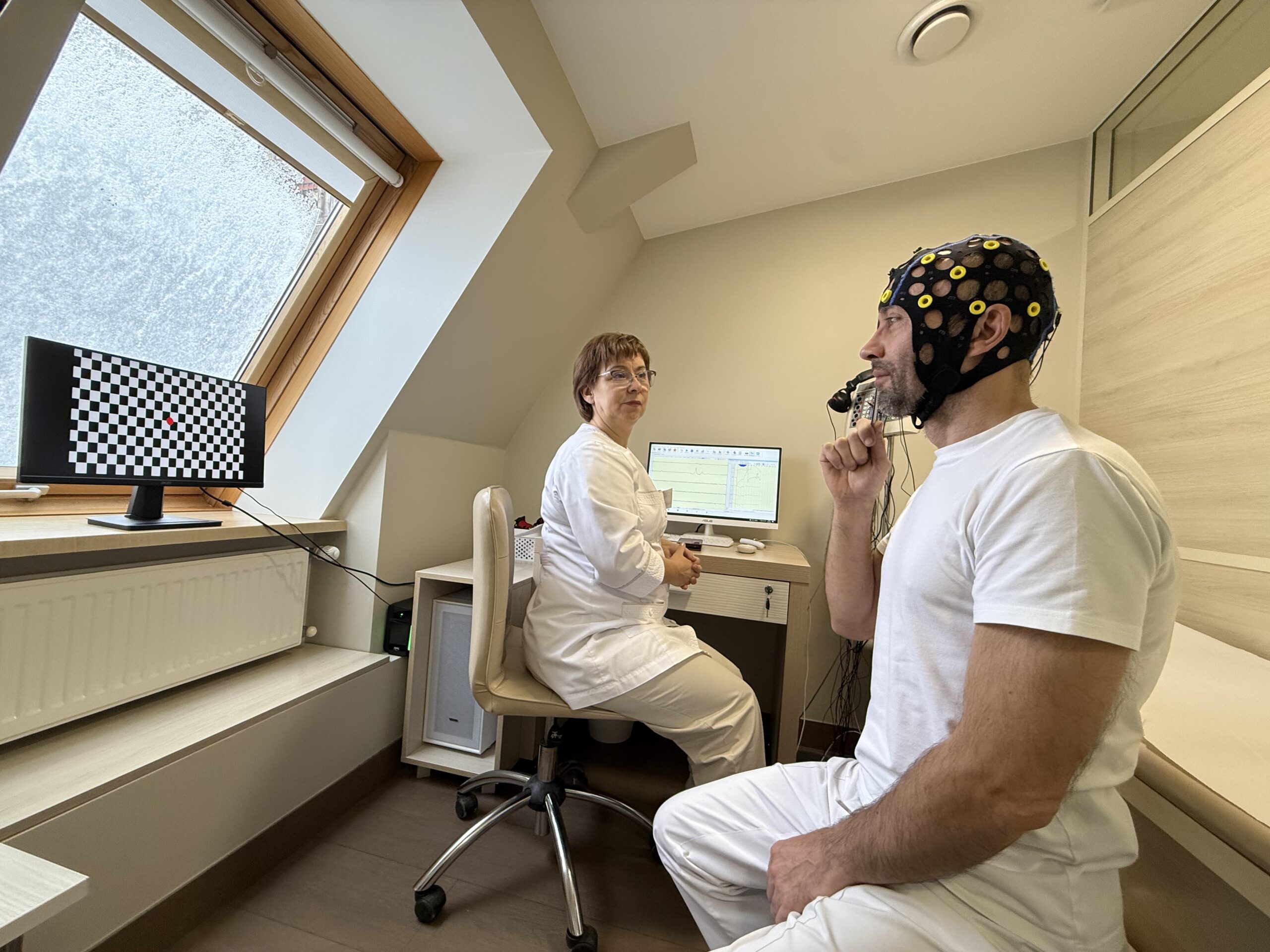
Visual evoked potentials (VEP) are a modern method of functional diagnostics that allows for the measurement of the speed and quality of nerve impulse transmission from the eye to the visual centers of the brain.
This is not a test of visual acuity; the examination does not depend on the patient’s subjective sensations but is based on recording the brain’s electrical activity in response to a visual stimulus. This makes it possible to detect damage to nerve fibers in the early stages, which is critical for successful treatment.
Read more about the capabilities of this method and its role in modern medicine in our article “Evoked Potentials: An Objective Assessment of the Nervous System.”
What do we assess using the ZVP?
During the examination, a comprehensive assessment of the entire visual system is conducted, specifically:

Retinal status: primary perception of light signals
Optic nerve: the quality of impulse transmission from the eye

Visual pathways: signal transmission through brain structures

Visual cortical areas (occipital lobe): final processing of visual information
Main Clinical Indications
This test is recommended for the following conditions:

Demyelinating diseases: suspected multiple sclerosis (MRI is one of the most sensitive methods for early diagnosis)

Optic neuritis and optic nerve atrophy: assessment of the extent of damage

Injuries: optic nerve damage resulting from a traumatic brain injury

Unexplained symptoms: decreased vision with no abnormalities found during an ophthalmological examination

Pediatric Conditions: amblyopia (“lazy eye”) and monitoring its treatment

Complex clinical cases: requiring differentiation between organic and functional disorders
The Key Value of ZVP for Your Treatment
The visual evoked potentials method allows for:

Pinpoint the location of the abnormality more precisely
at the level of the eye, the optic nerve, or the brain

Obtain objective functional data
are important for confirming the diagnosis

Detect problems at an early stage
even before significant changes become apparent using other examination methods
Schedule a consultation to find out how we can help you specifically.
Benefits of treatment with us

101 405
Our patients are once again leading active lives!
93%
Our patients were free of pain after a course of treatment
65
Countries around the world—our approach helps patients worldwide
854
Evidence-Based Treatment Protocols for Neurological Syndromes
How easy is it to book an appointment with us?
Leave a request for a consultation
Our specialist will contact you and clarify the details
We will choose a convenient time and doctor together
You will receive high-quality treatment and recommendations
Learn more about the cost of diagnostics.
Take the first step toward better health today!


Still have questions?
We’ll help you find the answers!
Fill out the form and our specialist will contact you shortly.
We are waiting for you in our center!
Contact center:
Adult department:
Hours of operation:
- Monday - Friday: 8:30 - 17:00
- Saturday: 9:00 - 13:00
- Sunday: day off
Children's department:
Hours of operation:
- Monday - Friday: 9:00 - 14:00
- Saturday, Sunday: weekend
How to find us?
How to get there
from the W/D station:
-
 by bus No. 7 (on weekdays)
 -
by bus No. 181
 by bus No. 7 (on weekdays)
 by bus No. 181
from Art. metro "Lukyanivska":
-
by trolleybus No. 6, 16, 18
-
by bus No. 181, 574, 527, 439
 by trolleybus No. 6, 16, 18
from Art. "Maidan Nezalezhnosti" metro station:
-
by trolleybus No. 6, 16, 18