


The intervertebral disc hernia is one of the spinal osteochondrosis complications and represents the maximum degree of protrusion of the pulpous nucleus of the disc with the rupture of its outer shell. The terms “intervertebral hernia” or “herniated disk” are also often used.
Causes and mechanism of intervertebral hernia
There is a genetic predisposition for the intervertebral hernia formation: this is due to a defect of proteins that make up the the disk membrane.Therefore, hernias can develop across young people, and even among children. But in most cases, the weakening of the fibrous ring fibers is still associated with age-related deformations of the disk tissues, because with age the disks lose their elasticity and moisture, and the membranes become more fragile and vulnerable. In addition, as a result of the reduced level of nutrient diffusion in the disc tissues; the synthesis of proteoglycans and collagen decreases, which also adversely affects its strength.
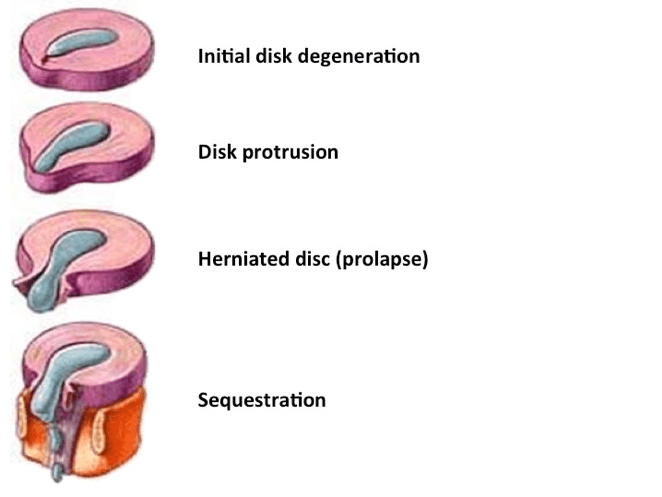
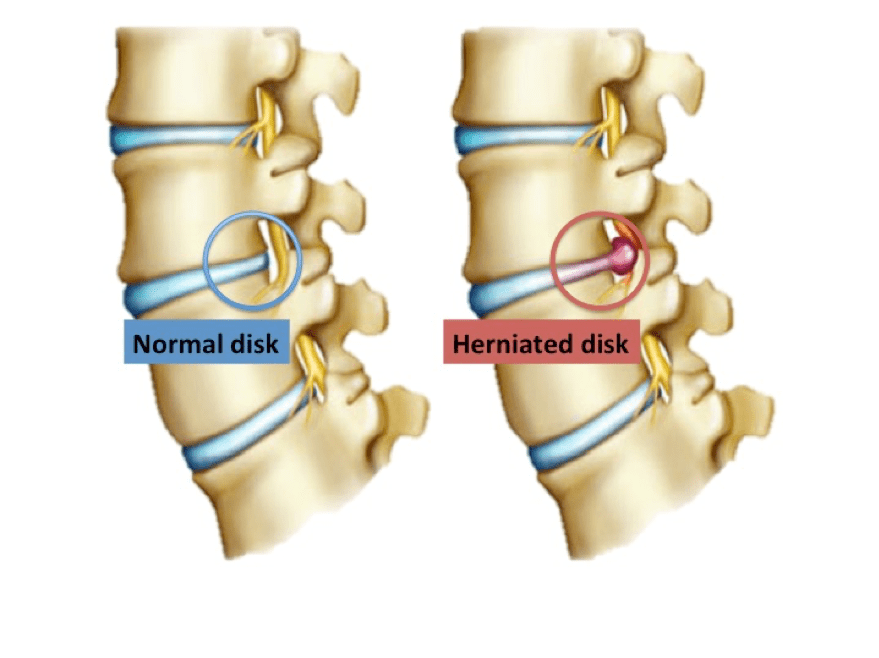
Intervertebral hernia is formed differently. In most cases, it appears on the background of the existing discs protrusion within several years and gradually increases. Sometimes it appears spontaneously due to a sudden rupture of the fibrous disc membrane at the moment of sudden lifting, injury or fall. Either way a crack appears in the outer shell layers, through this gelatinous content of the disk nucleus pulpous tends to go beyond its limits. Formed protrusion puts pressure on the spinal nerve root; a clinical disease (pain, numbness, muscle weakness) develops in this area.
Moreover, an autoimmune conflict may arise on the background of hernias, because the contents of the disc seem foreign to a human immune system; therefore, antibodies are released in response to the ingress of disk parts into the spinal canal lumen; that affects healthy intervertebral discs and leads to an inflammatory process in future.
In cases of very large hernias, sometimes a fragmentation of a small part of the hernia protrusion may occur, which can be located slightly below the level of the hernia itself, hanging in the form of a “drop”. This condition is called sequestration of hernia, and it requires an immediate treatment, because the breakaway part (sequestration) can squeeze the nerve roots at the appropriate level until the lower extremities paralysis, pelvic function disruption, increased numbness, and gait disturbance.
Classification of intervertebral hernias
Depending on the disk bulging direction, there distinguished the following types of hernias:
- Anterior (ventral) protrusion is directed forward and can irritate the anterior spinal ligament;
- Posterior (dorsal) – protrusion is directed backwards;
- Lateral (foraminous) – are formed from the lateral parts of the disc and lead to the spinal nerves roots squeezing.
It should be noted that the intervertebral disk hernia can develop in any direction. If you imagine a disk in a clock face form and look at it from above, there will be 12 directions – as many as the divisions on the clock-face. But in the majority of cases there develop above-mentioned types.
In addition, there exist left-sided and right-sided hernias (this can be determined on the basis of patient complaints and a thorough neurological examination; the conclusion of an MRI only confirms the neurologist’s diagnosis).
Symptoms of intervertebral hernia
The intervertebral hernias may develop in any part of the spine; but doctors often deal with lumbosacral spinal hernia (more than 70% of cases). This area is considered to be the most vulnerable due to its anatomical features: these five lumbar vertebrae undertake the maximum load.
With hernias of such localization, the patient complains of severe pain in the lumbar area with irradiation (spreading) to one or both legs, the inability to bend or straighten the trunk; he/she may have a gait disturbance due to the lower extremities weakness. Intense pain in the lumbar area is called lumbodynia, in the leg – ischialgia. Acute backache is called “lumbago.” In addition, the patient complaints of numbness (desensitization or hypesthesia), goosebumps or lower extremities sense of discomfort. Increased sensitivity is called hyperesthesia and manifests itself in the form of excessive pain at a touch this skin area.
Cervical spine hernias, vascular disorders associated with the vertebral arteries compression at a neck area accompanied by painful neck and arms sensations (cervicalgia, brachialgia). Vascular symptoms are manifested in the form of visual impairment, hearing, memory impairment, attention, headaches and dizziness.
Thoracic spine hernias are less common (1-2% of cases), but they are distinguished by stubborn, painful pain, because the fibers of the autonomic nervous system are often involved in the pathological process. Such hernias are often disguised as visceral diseases; that is why many people apply to the cardiologists, gastroenterologists, and therapists first. Symptoms of a thoracic hernia depend on its localization and size – these may be chest pain (thoracalgia), back skin and shoulder blades or belly front wall numbness, arms atonia. Pain syndrome often resembles an intercostal neuralgia, i.e. pain with a specific engirdling manner, which is intensified while coughing, sneezing and moving.
The arrow shows, how a hernia of the intervertebral disk L5-S1 squeezes one of the spinal ganglia.
Treatment of intervertebral hernia
Disk herniation is a condition that requires serious and prolonged treatment. No doctor is able to save you from a spinal hernia within a short period of time. You should understand that the restoration of intervertebral discs is a long process (it takes about 2 years), therefore the treatment program should be scheduled for at least 2 years and should include a complex therapeutic effects.
Intervertebral hernia treatment at the Bersenev’s Medical Centre will give you the opportunity to get rid of pain forever and provide a stable remission. We apply a unique metameric method of intervertebral hernia treatment; the treatment sessions are carried out by the qualified doctors – specialists who have undergone preliminary training in this technique. Our doctors know how to treat intervertebral hernia.
Many years of experience shows that herniated disk treatment is possible without surgery – if you adhere to all medical recommendations and be adjusted to the result. Surgical intervention and removal of hernia is surgically indicated in cases of certain spinal cord structures compression along with urinary and stool incontinence, legs or hands paralysis, and perineum numbness. After the surgery, a person needs long-term rehabilitation and complex treatment. Therefore, in our medical center, people who have undergone herniated disk surgical interference also are being treating.
Doctors of Bersenev’s Medical Centre have developed individual program for home treatment, since it is necessary to continue the treatment at home between the metameric treatment courses — take certain medication, follow your mode of life, perform therapeutic exercises, etc. In our clinic patients can also undergo a course of metameric massage, which improves blood muscles circulation, reduces their spasms, and favorably affects the disks lymphotrophy. All these procedures in a certain sequence and compatibility lead to the patients’ recovery and release from pain forever.
To make an appointment for a consultation or a herniated disk treatment session, please, call (044) 238-22-31 (call centre). The booking is carried out by previous appointment.
Do not delay your visit to the doctor – call us today!


 by bus No. 7 (on weekdays)
 by bus No. 181
 by trolleybus No. 6, 16, 18